Why Do We Struggle? Three Common Theories— and a Better Way Forward
When someone experiences anxiety, anger, depression, emotional numbness, unhealthy habits, or repeated relationship problems, we naturally want an explanation.
Why is this happening?
What is wrong?
How do we fix it?
The way we answer those questions matters. Our explanation shapes how we view the person, how we respond to their struggle, and what kind of help we believe they need.
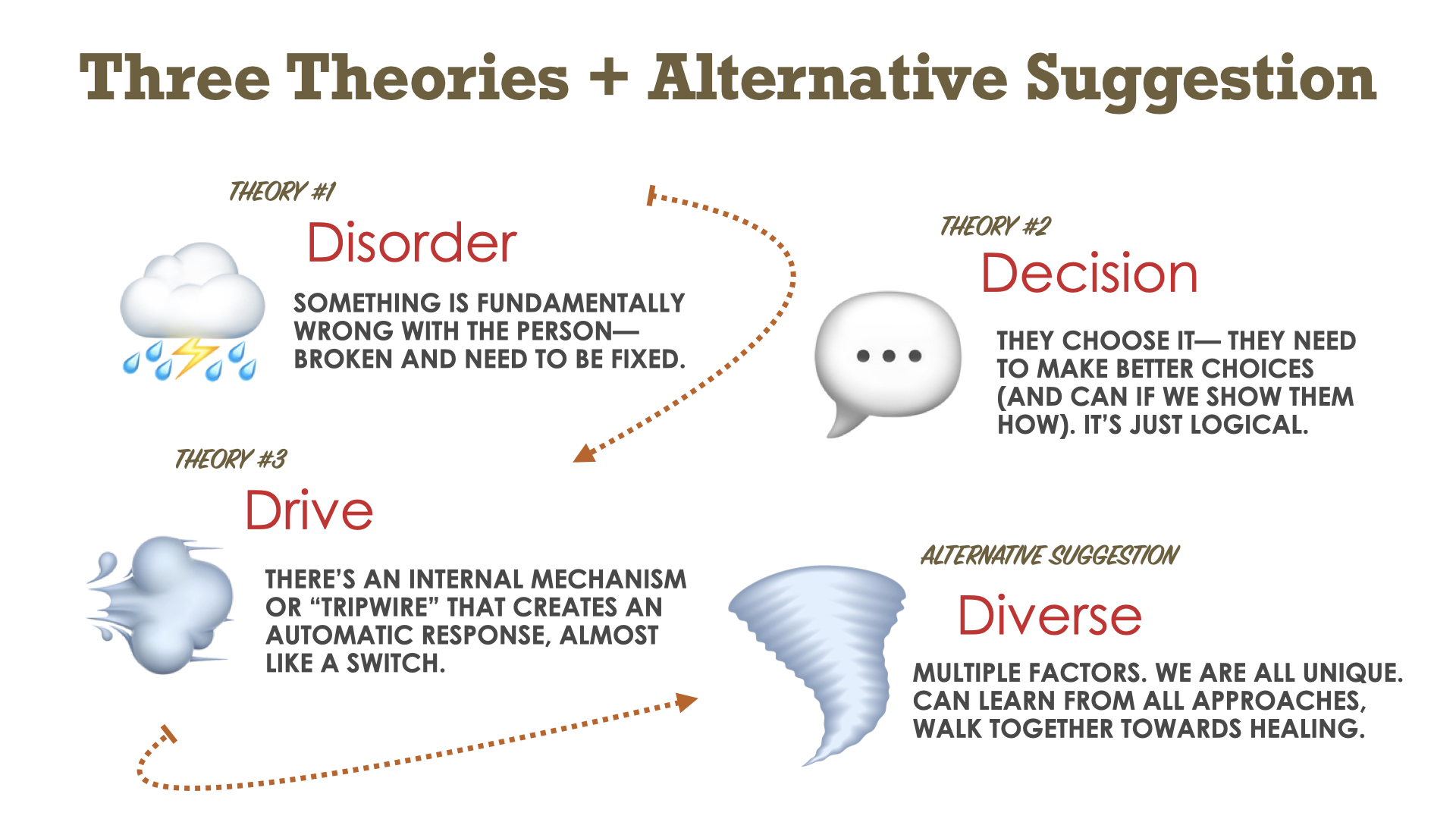
There are three common theories people often use to explain emotional and behavioral difficulties: disorder, decision, and drive. Each theory offers something useful, but none of them tells the whole story. A more complete approach recognizes that people are complex, every situation is different, and healing often requires wisdom from multiple perspectives.
Theory One: Disorder
The disorder theory says that something is fundamentally wrong within the person. Their symptoms may be understood as evidence of a mental, emotional, or physical condition that needs to be diagnosed and treated.
This perspective can be valuable. A diagnosis may help someone put language around an experience that once felt confusing or shameful. It can also connect a person with professional care, appropriate treatment, and helpful resources.
However, this theory can become harmful when a diagnosis begins to define the person.
A person is not simply a disorder. They are not merely “broken,” and they should never be reduced to a label. Their symptoms may be real and serious, but those symptoms exist within a larger story involving their body, relationships, experiences, beliefs, environment, and spiritual life.
Diagnosis can be a helpful tool. It should not become an identity.
Theory Two: Decision
The decision theory assumes that people choose their behavior. From this perspective, the solution is to help them recognize the consequences of their choices and teach them to make better ones.
Personal responsibility certainly matters. Our decisions affect our health, our relationships, and our future. Healing often requires honest reflection, changed behavior, healthy boundaries, and a willingness to take a different path.
But it is not always as simple as telling someone to “make better choices.”
Trauma can affect how a person perceives danger. Chronic stress can reduce their ability to think clearly in the moment. Fear, shame, exhaustion, and unresolved grief can influence behavior before someone has time to consider every option logically.
A person may be responsible for their actions while also needing help understanding the pain, patterns, and pressures behind those actions.
Accountability is important, but accountability without compassion often produces more shame rather than meaningful change.
Theory Three: Drive
The drive theory suggests that people have internal mechanisms that create automatic reactions—almost like a switch being flipped.
This may include the body’s fight, flight, freeze, or shutdown responses. A sight, sound, smell, conversation, or stressful situation can activate an intense reaction before the person consciously understands what is happening.
This is especially important when discussing trauma. Someone may know intellectually that they are safe while their nervous system continues to respond as though the danger is still present.
Recognizing these automatic responses can reduce shame. The person is not necessarily weak, irrational, or intentionally difficult. Their mind and body may have learned to survive a threatening experience and are continuing to use that survival response long after the immediate threat has passed.
Still, biology and automatic reactions are only part of the picture. People are not machines controlled entirely by internal switches. They can learn new skills, develop healthier responses, receive support, and grow in their ability to regulate their emotions.
An Alternative Suggestion: Diverse
Rather than forcing every person into one explanation, we should consider a more diverse and integrated approach.
Human beings are complex. Emotional disruption may involve several factors at the same time:
- Physical health and brain chemistry
- Trauma and previous experiences
- Current relationships and environment
- Habits and personal decisions
- Grief, guilt, or unresolved conflict
- Spiritual questions and moral injury
- Learned survival responses
- Available support and resources
One person may benefit from counseling. Another may need medical care, spiritual guidance, a supportive community, practical lifestyle changes, or some combination of these.
The goal is not to determine which single theory wins. The goal is to understand the whole person and walk with them toward healing.
Normal Responses to Abnormal Events
Many emotional disruptions are normal human responses to abnormal events.
A veteran who remains alert in crowded spaces may have learned that awareness keeps people alive. A first responder who feels emotionally numb may have developed that response after repeatedly witnessing tragedy. A person who experienced betrayal may struggle to trust because trust once resulted in deep pain.
This does not mean every struggle should be ignored or left untreated. It means we should approach people with curiosity rather than condemnation.
Instead of immediately asking, “What is wrong with you?” we can ask:
- What happened to you?
- What are you carrying?
- What helped you survive?
- What would healing look like now?
Not everyone experiencing emotional difficulty meets the criteria for a mental health disorder. Even so, nearly all of us have areas in which our emotional, relational, physical, or spiritual health could become stronger.
Walking Together Toward Healing
Healing rarely happens through a single explanation or one quick solution. It happens when people are seen, heard, supported, and given the tools they need for their unique journey.
We can learn from medical professionals, counselors, pastors, chaplains, peers, family members, and those with lived experience. Each may see a different part of the story.
The most helpful question may not be, “Which theory is correct?”
It may be, “What does this person need in order to take the next healthy step?”
We are all unique. We can learn from multiple approaches, extend grace to one another, and walk together toward greater health and healing.