
Neuroscience made simple
There’s a reason we respond / react the way we do. And a little (over-simplified) brain-science helps us understand it…
That said…
👇
Three of the key players must know in order to understand hijacked emotions are the amygdala, the thalamus, and the hippocampus— all labeled in this image.
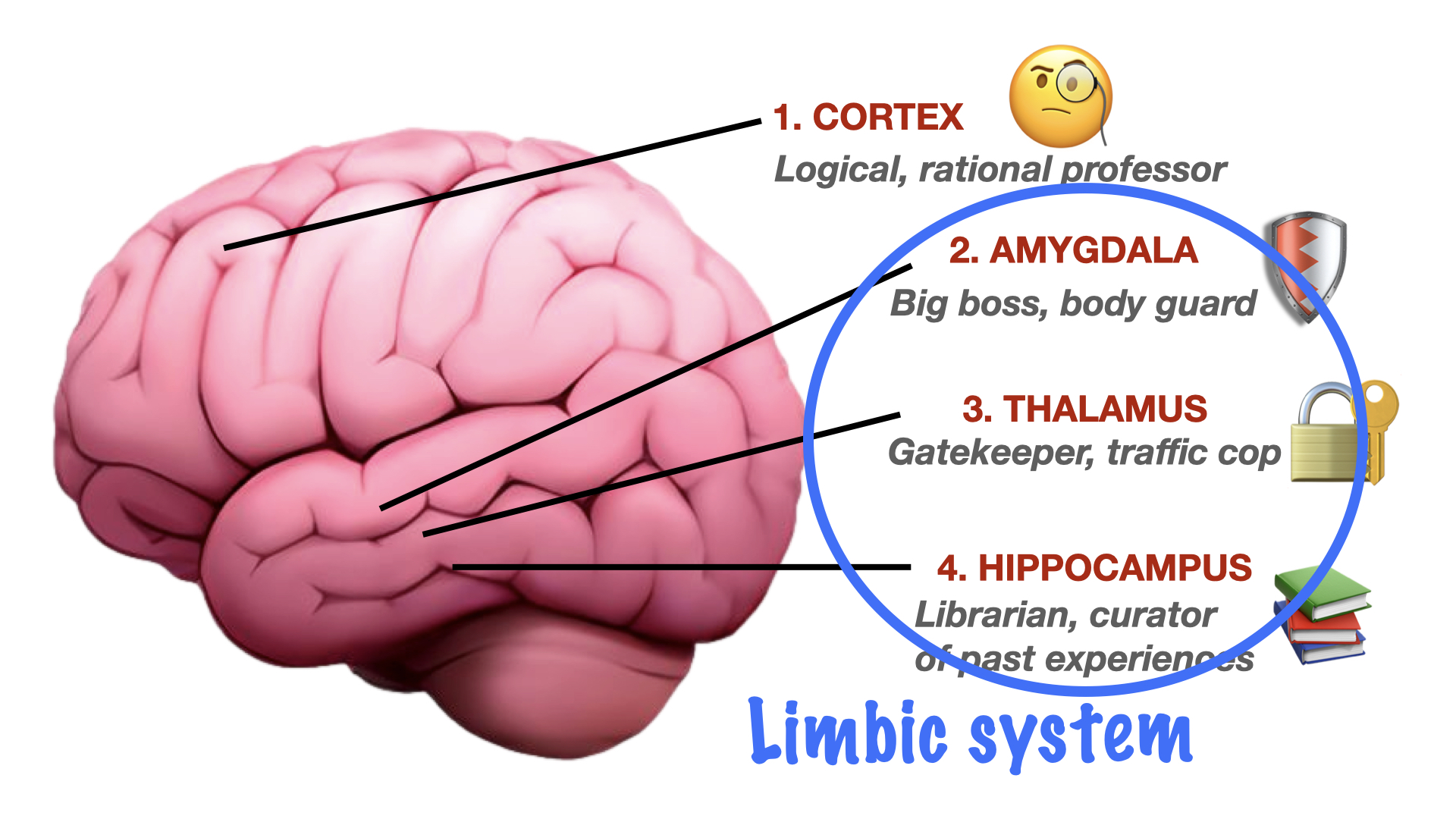
They’re part of the “limbic system,” which will become important in a moment.
For now, understand that the limbic system controls:
❤️🔥Our emotions
⚙️Our “drives” (i.e., hunger, sex)
The cortex, the first in the image, is part of the “logical” brain.
Now, let’s describe what they do— and how they work together.
The four players
Here’s an overview. The descriptions come from Dr. Theodore George’s book Untangling the Mind. (The quotes below come from his book.)
🧐 Cortex = Logical, rational professor
- The cortex is the advanced part of the brain controlling thought, intention, and action…
- The cortex normally acts as a brake on strong emotion by applying reason, explanation, and definitions.
🛡️Amygdala = Big boss, body guard
- The amygdala is critical to handling sensory information, especially signals that convey a threat or danger.
- It functions so fast that it registers possible danger before you are aware of anything threatening.
- … in the face of danger, the amygdala takes charge of the body’s entire survival system… When it comes to danger and fear processing, the amygdala is the boss.
🔐 Thalamus = Gatekeeper, traffic cop
- The thalamus functions as a gateway for sensory information … [sent] to the cortex and to the amygdala.
📚 Hippocampus = Librarian, curator of past experiences
- The hippocampus provides the amygdala with vital extra information— it shares memories and experiences so that a threat can be given a context to determine how dangerous it really is.
The real world
In light of what we just learned, let’s describe what occurs in everyday life when we receive sensory data correctly and when we read it incorrectly.
For clarity, we’ll walk through two scenarios here:
Scenario #1 = we read sensory data correctly and respond in a healthy, helpful manner.
Here’s what happens on a “normal” day. This step-by-step process (which happens in milliseconds) follows an extremely orderly flow:
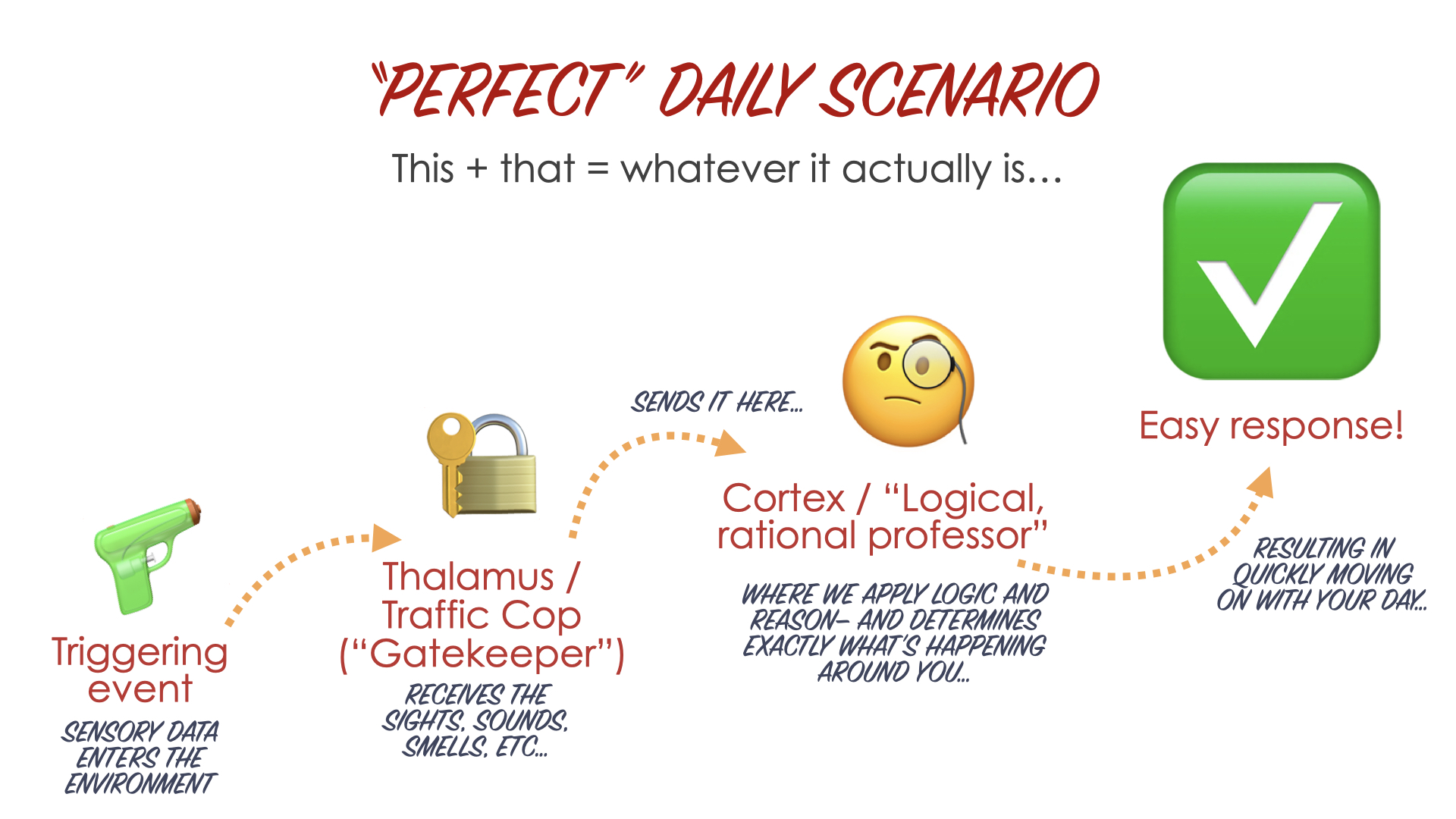
The pic above shows a “mind map” of what occurs.
🔫 Triggering event occurs = sensory data enters the environment
🔐 The Thalamus / Traffic Cop (“Gatekeeper”) = receives the sights, sounds, smells, etc. (all of which have been stored in your body, unbeknownst to you)
🧐 Cortex / “Logical, rational professor” = gets the information and applies logic and reason— and quickly determines exactly what’s happening around you
✅ Easy response = resulting in quickly moving on with our day
But what if…?
Now, let’s consider it another way.
Scenario #2 = we read the sensory data incorrectly and react in an unhealthy, harmful manner.
Think about it in light of the brain science you now know.
😳 What happens if that sensory data— instead of being routed to the cortex— rushes to the amygdala (that part of the brain which handles threats and manages our survival instincts)?
🤯 And what occurs if the hippocampus (the little library of memories) adds information from the memory bank of your history regarding your experiences of what you saw, sensed, and stepped through in your past?
Rather than the reasoned response from the cortex (i.e., the professor), the amygdala (the boss / bodyguard) takes over.
🤷♂️
Here's why...
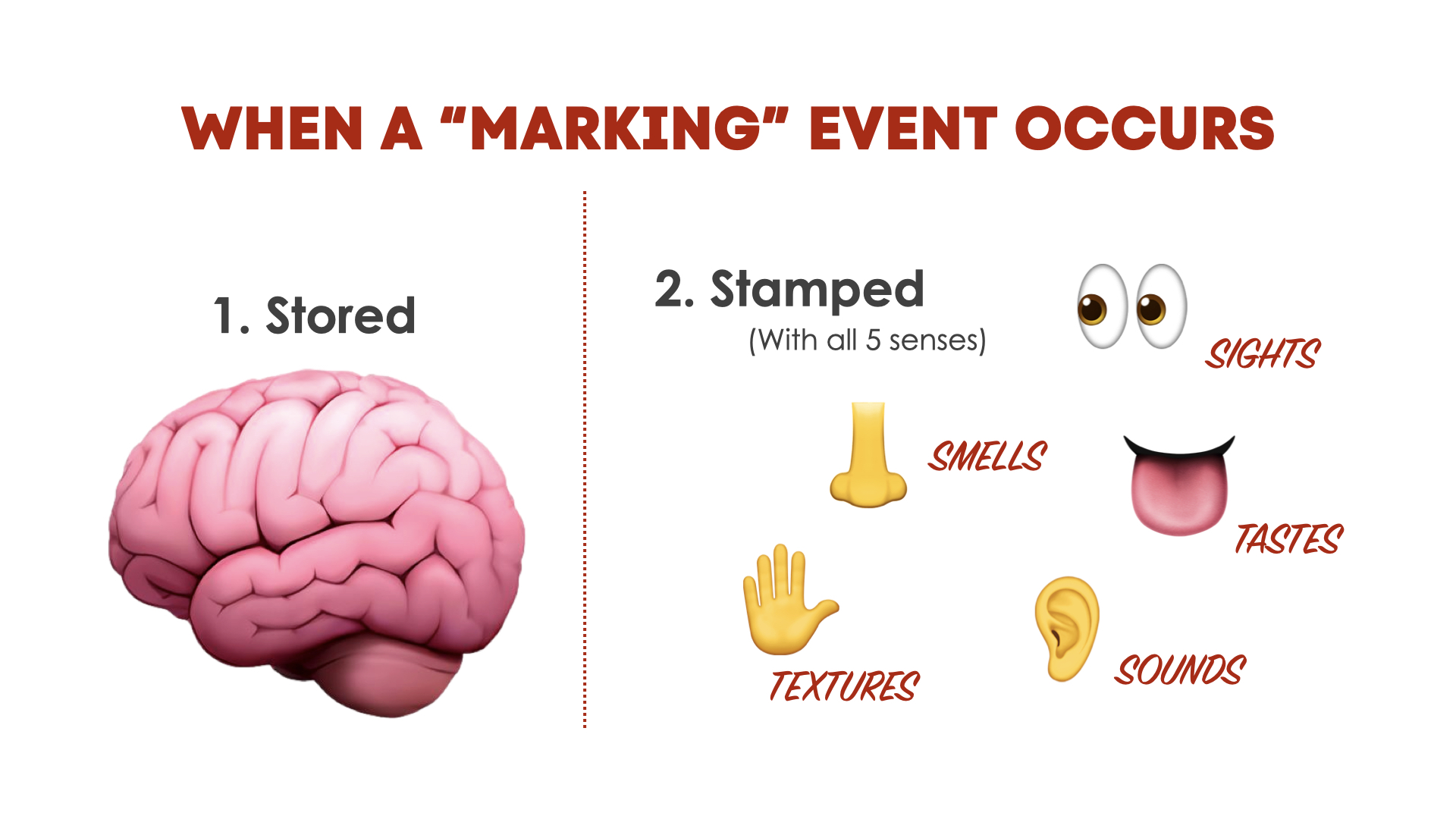
Every time a memorable event occurs (positive or negative), your “body” stores the memory AND stamps all of the sights, sounds, smells, tastes, and textures WITH that memory bank…
… such that when you encounter the same stimuli in the future, the past memory (and the protective response, if it was a harmful event) come rushing back…
… and you react AS IF you are in the same situation (even if you’re not).
So…
Think about the brain filing all of your memories along with associated sights, sounds, and smells. It’s all “stored and stamped.”
Chad Robichaux states it like this in his book The Truth About PTSd.
If triggered, our body immediately goes back to the settings of that day: heart rate, adrenaline, vision, audio exclusion, hyper-vigilance, etc.
You’ve likely experienced it before. Everything flips. Your survival instinct kicks in, causing you to prepare to fight (run towards the conflict), flight (take evasive action), freeze (i.e., disappear intentionally or unintentionally), or fawn (placate and pacify) without even thinking about it. The perceived threat may not be real, but it certainly feels real.
So, we don’t respond as outlined above.
Instead, we react like this...
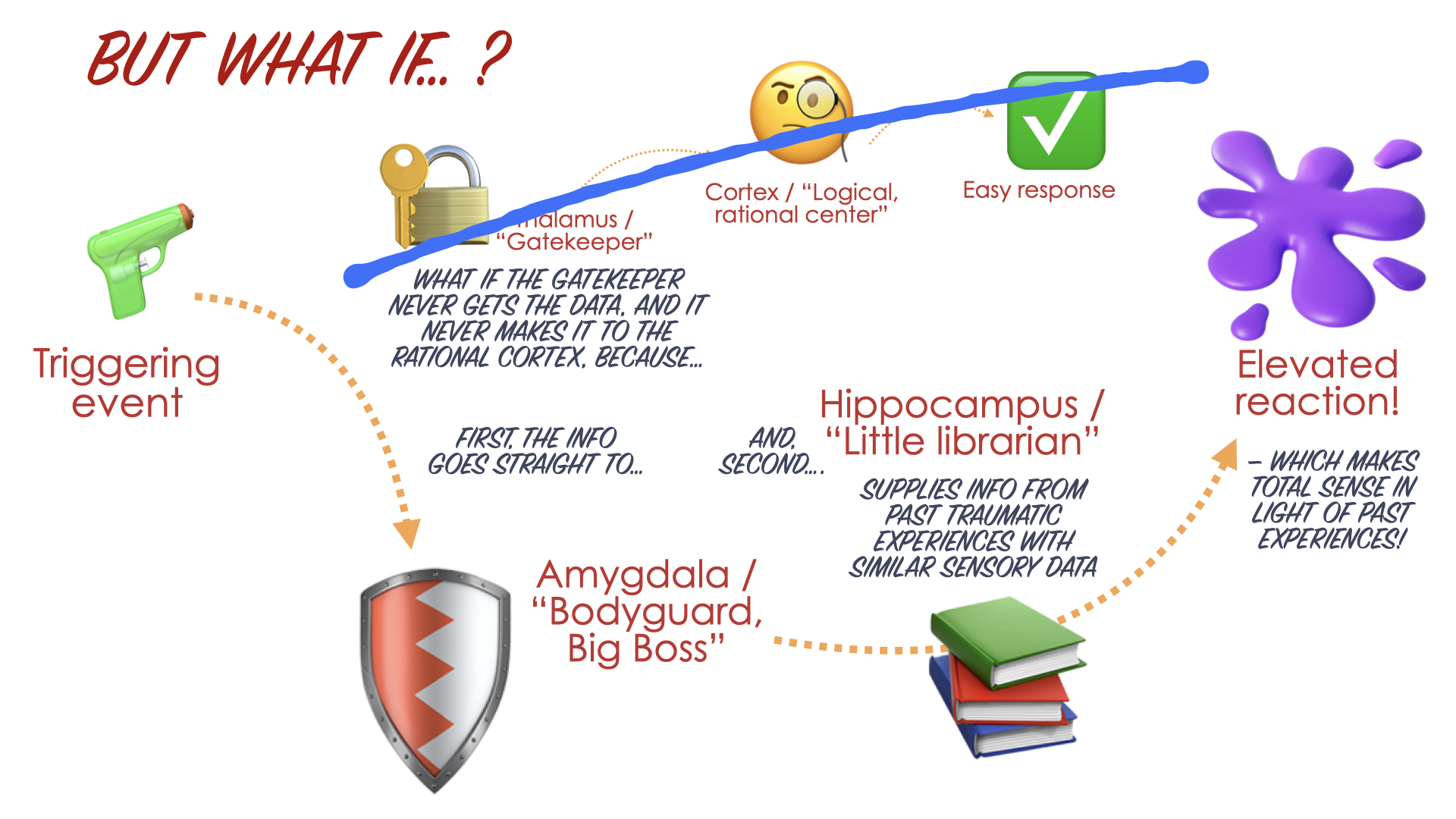
People standing nearby— people who do not share your experiences and don’t have the backlog of data stored in their hippocampus (#4, the librarian) that you absolutely need in order to do your job well— move on.
They may have been momentarily startled by the triggering event but their thalamus (#3, the gatekeeper/traffic cop) heard the sound, then sent the data to the cortex (#1) and then the “logical professor” informed them there was no threat.
Next steps
Watch the Emotional Wholeness Checklist video here.
Or access the Field Guide course here.